To be terminated, or not to be terminated? We live in a timeline, in which movies are not only a dying art, but a failing business. In an age when superheroes fought Grimace lookalikes (before he could release the Grimace shake), and the story is secondary to the amount spent on special effects, the industry is a mixed bag of terrible. Within this mixed bag, we have the genre of, “Avengers: Endgame made money, ohhh it did time travel and multiverse stuff, let’s do that, trust me guys, it will work.” Within four or five years of watching this genre, barely any of them are good and they ruin characters that we love.
Well, well, well, well, well, well, well… well… well. It has been said that those who do not remember history, are doomed to repeat it. What has been forgotten in this case is that when you oversaturate the market, people lose interest (and go ‘on strike’ from seeing your terrible movies (so to speak.)) it could be argued, that the success of Endgame was also what doomed major parts of the modern blockbuster. You might even say that its release date, April 26, 2019, was Judgment Day.
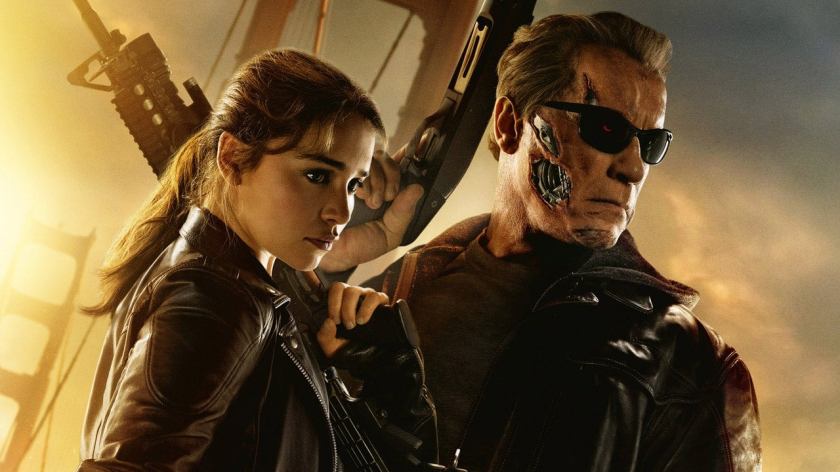
This leads us to hop into a Delorean ourselves and travel allllllll the way back to the summer of 2015. A time in which no one knew who the heads of movie corporations were, and the term Soft Reboot was as foreign as high gas prices. Of the summer films, my family went to see the newest installment of the Terminator franchise, Terminator Genisys. I walked out hating this movie, wow, I mean, it was not good. Or so the legend says.
See, I had a brother tell me it was good. To prove I was right, I bought him a copy of the film later that year and told him he would never open it and that the day he did he would have given up on watching good movies. For eight long years, it sat in his 2001 Toyota Tundra, never to be opened, like the film’s plot itself, forgotten… This story picks up in the present day when after watching the abomination that is 2023’s, The Flash, the time to join the resistance had come. We put in the Blu-Ray, and as I sat there, I couldn’t help but think, “Wait, why was this so bad?”
With a new perspective comes change, and the change I’ve come to realize is not only is Genisys a pretty entertaining and fun action film, but its story ideas hold the key of what was t come and is ahead of its time. What are the key elements found here that modern blockbusters lack such as The Flash, Spider-man: Across the Spider-Verse, Doctor Strange in the Multiverse of Madness, or even Lightyear?
To start we’ll look at nostalgia bait. When Multiverse of Madness was somewhat of a success, every studio involved learned the wrong lesson. “Oh, people want cameos, let’s throw as many cameos into the movie as possible.” It seems like a really great way to bring in all sorts of famous actors to return to fan-favorite roles, yet rarely has it worked in execution. Sometimes, you can find a fantastic performance in a terrible film, such as bringing back Micheal Keaton as Batman in The Flash. For every Keaton, unfortunately, you have about 50-500 times where the cameo is horrible on every level, such as the entire Illuminati sequence near the end of Multiverse of Madness which does not affect the plot and only serves as an excuse for cameos.
Genisys is very smart about what nostalgia and cameos it uses to impact the story and characters. While the structure of nearly every previously mentioned film waits until the end to bring out the cameos, Genisys does the opposite. It baits the audience into the story by recreating scenes from the 1984 original, yet with some twists here and there, and then after the first act tells its own story without relying on nostalgia. Its best cameo or reference to past films would be old Arnold fighting new Arnold, this is a fun action scene that matters to the plot.
On the topic of this fight, the use of Arnold contributes to the story and treats his character and the audience with respect. In many franchise long-awaited sequels, we see how much disrespect the writers have for our favorite legacy heroes. The easiest example is Luke Skywalker in his return, though that’s not exactly what this article is about. Instead, we can look at Patrick Stewart’s cameo in Multiverse of Madness as Professor X; It’s horrible.
He shows up for nothing but fan service and is a lame addition to the cast. We’ve seen this character use his mind to accomplish insane feats, to the point where he is so powerful in Logan, he has to be given medicine to subdue his seizures which have the power to kill people in a city-wide radius. His return adds nothing to his mythos or character and in 5-10 minutes he’s killed in a pretty dumb way.
Now it’s not the most perfect comparison as Arnold is throughout the entire runtime of Genisys, but if we compare only when the young version of the T-800 shows up, the point is still made. The original Terminator was not a protector, he was a ruthless killing machine and you get to see that in the few minutes before he’s killed off. You can have a fun action scene while also respecting the source material, it’s really not that hard.
I remember, at the time, being incredibly confused by Genisys’ plot, yet with time, it’s not that hard to follow at all. There is plenty of exposition to explain timelines, how time travel works, and why the characters are different than they were when we last saw them. Though here, it’s scattered throughout the plot and doesn’t treat the audience like newborns marveling at simple magic tricks. A lot of the films in our new genre overcomplicate the timeline and multiverse attributes of the story, a perfect example of this is Spider-Man: Across the Spider-Verse.

Spider-Verse has a terrible script structure, to start, where they stretch what should be the first act to 2 hours, though when we finally get to the scene where they explain the multiverse it is not very well done. They don’t explain how the multiverse works for everyone, but only for each version of Spider-Man???? Things like how each Spider-Man has a canon event that cannot be changed without major consequences. The only canon event here is how poorly the exposition is written in this scene and does not keep the audience engaged.
The future of several franchises is stupidly relying on the multiverse to sell their mediocre scripts. It’s already an old and dying trend. Yet before it was a trend, and writing this next part hurts 2015 me, but Terminator Genisys accomplished what many of these films struggle with on several fronts. It’s a fun action film, that uses altered timelines and variant versions of well-known characters to evolve the world of Terminator. Though surface level, there’s even some fun with the subtext, can robots feel, and how knowing the future affects the present, these different elements add to the film as well.
Whether the films make money or not, the future of the blockbuster and “Avengers: Endgame made money, ohhh it did time travel and multiverse stuff, let’s do that, trust me guys, it will work,” genres and style of film are here to stay for the foreseeable future. If they want to be successful, it only benefits all parties involved if producers took 2 hours out of their day to watch the fifth Terminator movie and took some notes. Otherwise, the studio’s ability to make money, and the capacity of the audience to remain entertained, will be terminated.
 MooCow Entertainment
There’s a few edits but who cares, still a good article
LikeLike