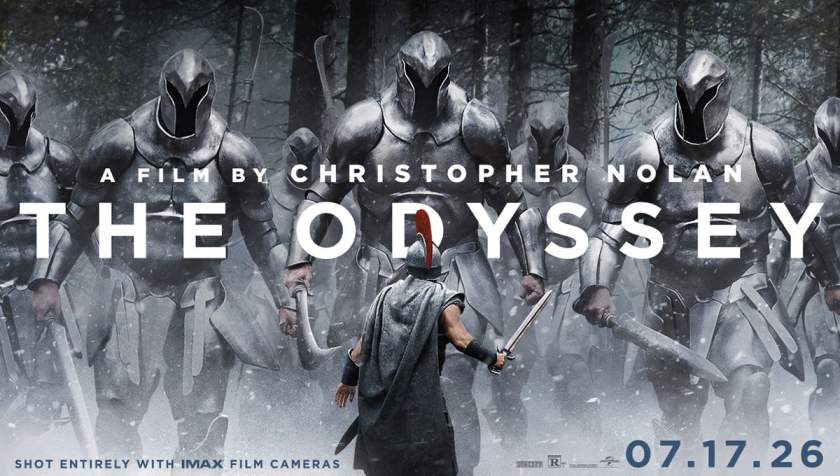
Christopher Nolan is one of the few filmmakers who can pretty much make whatever movie he wants. Should he?
What are the elements of faithful adaptations? Is it to bring the source material to life, shot for shot, with no exceptions? Is it to change everything but the name and make it your own? I have grown up in the world of adaptations. From superheroes, video games, and literature. Adapting an already established story from one format to another might be one of the hardest challenges for any creative. That, and, of course, figuring out how many licks it takes to get to the Tootsie Roll center of a Tootsie Pop.
I would argue that, for the most part, any changes made from the original source material need to be beneficial or complementary ideas. Look at Iron Man, a character who was redeemed in the live-action films, rather than sticking to his purely alcoholic comic book ways; that change makes sense. As long as the adaptation keeps the themes and tone of the original vision, most changes are okay.
The Odyssey is a nearly 3,000-year-old poem written by Homer. It tells the story of Odysseus’s struggle to return to his home of Ithaca after the Trojan War. It’s one of those things like the bible, or how many licks it takes to… well, you get the idea; The Odyssey is truly iconic. Whether you’ve read this epic poem or not, it has influenced so many other stories that you have probably, without realizing it, known a good chunk of this tale your whole life. You might be familiar with the word “mentor“; it was used in ancient Greek texts, and the way we use it today came from how it was used in The Odyssey — food for thought.
Anyone who knows me knows my love of “The Gods.” Meaning, throughout my life I always reference how the Greeks viewed their gods as real. I make those jokes because of The Odyssey. So yes, when I was working construction and a homeowner was surprised at our progress on a build, and I responded with, “Perhaps the gods of old have not forgotten your sacrifice, my friend,” and the homeowner had no idea what I was talking about, it was hilarious. No one can convince me otherwise. Odysseus’ story of getting home and reclaiming his throne, protecting his wife and son, overcoming his pride, and accepting the fate the gods have in store for him has inspired me since I was a boy. He is one of my favorite characters from any kind of storytelling method, period.
While watching The Odyssey, it seemed like Nolan really liked ships and shots of the ocean and really wanted to film the legendary sacking of Troy. But it didn’t really feel like he wanted to make a movie about, you know, The Odyssey. But I digress; let’s start as I always try to, with the good, and don’t get me wrong, there is plenty of that here. With that in mind, spoilers for both a 3,000-year-old tale and the 2026 adaptation.
The film’s most impressive feat is being the first movie fully filmed with IMAX cameras. That said, I did not see this movie in IMAX. Even without seeing it in that format, this film’s cinematography is at times heart-stopping. The sacking of Troy was one of the most intense moments in a recent film I can remember; it was absolutely the highlight of the movie. It cuts back to this throughout the film. Genuinely, it was looking at these scenes that showed the ultimate power of Nolan’s directing that made me think, why didn’t he just adapt The Iliad? (Homer’s epic that takes place right before this story.) Every scene that had nothing to do with the original story was the best part of the film. Not that Troy isn’t integral to The Odyssey, but it is not the focal point.
There is something really cool composer Ludwig Goransson does with the music. He used only musical instruments from the time the story takes place. (Find an article on that here.) Along with that, the music works well at helping set up Odysseus’ confrontation with the suitors on Ithaca. Ithaca’s theme is played only in moments on the island, or when characters are discussing this land. HOW CLEVER. No, but really, when we hear this theme in the film, it is used to help the audience think of the peace of home; of the end of the journey.
Similarly, the film sets up Odysseus’ iconic bow, along with how he plucks his bow before shooting an animal, giving it a fighting chance. When the challenge happens at the end, and only he is able to string his bow, the film combines both these elements. As the theme of Ithica starts to play, one of the music cues is instead replaced with Odysseus plucking his bow. This was an incredible, cleverly hidden setup and payoff. It tells us that he is done messing around and that his peaceful home is going to turn into a bloodbath, while also showing him warning his enemies to give them a chance. They are his prey; he is their predator.
It is impossible not to bring up the use of practical effects. It really brings you into this world. The set design of Troy is the best in the film. When they are burning that city, they are really burning the set, in shot. One of my favorite shots comes from a small moment, as Odysseus is looking around at men killing men; he is in focus in the front of the frame, he turns around to watch a tower crumble behind him, and it rack-focuses to the tower. I can’t imagine the headache of having a burning tower collapse at the exact moment you’ve staged your actor to turn and look at it. Very impressive.
Though on a technical filmmaking level, The Odyssey is astounding in many ways, it also sucks.
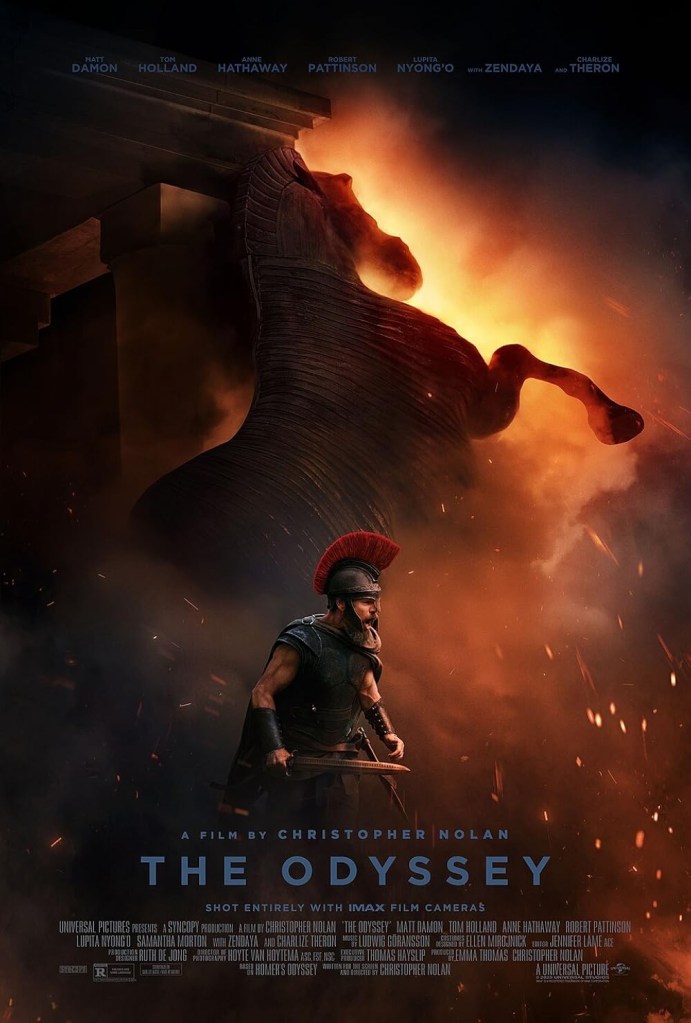
The way that, after a decade, the Greeks were able to infiltrate the impenetrable walls of Troy was by hiding inside a wooden horse and opening the gate from inside. Thus, the term Trojan Horse. Why did Nolan make this film? Nolan was originally set to direct the 2004 sword-and-sandals spectacle, Troy. Which is pretty much just a loose adaptation of The Iliad. Behind the incredible special effects and breathtaking cinematography, we find our answer, waiting to kill us in our sleep. This new version of The Odyssey is itself the ultimate Trojan Horse.
If they had called this film Christopher Nolan’s Tales from the Old Greeks, this would be an A– film without debate. Unfortunately, it’s called The Odyssey. As an adaptation of Homer’s epic, it’s a profound disappointment. Nearly every major change diverts from the story’s original purpose. In many ways, the script feels less like an adaptation of Homer and more like a remake of Ulysses (1954), which starred Kirk Douglas. That film also took liberties with the source material, for example, combining Circe and Calypso into a single character. Here, however, the changes fundamentally weaken the story. Odysseus, played by Matt Damon, is little more than a shell of the original character.
This is best illustrated in the first major sequence: his encounter with the Cyclops. It’s one of my favorite scenes in all of literature, and it’s astonishing how poorly it translates to the screen here.
After he and his men become trapped in the Cyclops’ cave, Odysseus realizes brute strength won’t save them. The Cyclops, Polyphemus (a son of Poseidon), begins devouring his crew one by one. Rather than charging into a hopeless fight, Odysseus devises a plan. He offers Polyphemus strong wine, gets him drunk, and when the giant falls asleep, he and his men drive a sharpened stake into his single eye.
Before doing so, however, Odysseus tells the Cyclops that his name is “Nobody.” So when Polyphemus cries out in agony, and the other Cyclopes rush to help, they ask who has attacked him. His only answer is, “Nobody is killing me!” Believing there is no real danger, they leave him alone.
It’s a brilliant display of the same strategic mind that conceived the Trojan Horse. Odysseus triumphs not through strength, but through deception, quick thinking, and psychological manipulation. Those qualities define him throughout Homer’s epic. They are almost entirely absent here.
In Nolan’s adaptation, there is no comparable display of cleverness. Instead, Odysseus comes across as arrogant, reckless, and surprisingly foolish. It feels like an entirely different character wearing Odysseus’ name. Rather than orchestrating one of mythology’s greatest feats of trickery, he stumbles from one event to the next while his men somehow conclude they’ve angered Poseidon simply because they hear the Cyclops call out to him.
Most baffling of all is the omission of the “Nobody” deception, arguably the entire point of the scene. Without it, the encounter loses the defining moment that demonstrates why Odysseus is celebrated as the greatest strategist in Greek mythology. But, in his arrogance as they are sailing away, he yells his real name to the giant, which adds to his struggle to return home. In Homer, Odysseus first proves himself the cleverest man alive, only to undermine his own brilliance with a burst of pride. The triumph and the flaw exist side by side, making him a deeply human and compelling hero. Nolan keeps the flaws but removes the genius that gives it meaning.
When asked about removing it, Nolan explained, “It’s a pun. Puns in translation are tough… I tried. It was not possible to work it in.“
Sure, buddy.
On that note, Nolan did a fantastic job grounding Batman in reality throughout his trilogy starring Christian Bale. That approach worked because Batman is a man who dresses like a bat; you can explore his psychological nature, naturally. Making villain Bane, for example, a more conventional terrorist in The Dark Knight Rises fits the grounded world Nolan spent two previous films establishing.
But that approach doesn’t translate to The Odyssey. Here, Nolan seems unable to decide whether or not the gods are real, and the inconsistency becomes incredibly frustrating.
The film opens with a title card reading, “A time of apparent magic.” Okay… so what exactly does that mean? The movie features three-headed sea monsters and witches who transform men into animals, yet Athena, one of the central divine forces in Homer’s epic, is reduced to a PTSD hallucination of someone Odysseus watched die during the sack of Troy.
You can’t have it both ways.
Either the supernatural exists, or it doesn’t. If Circe’s magic is real, why isn’t Athena? If three-headed sea creatures are real, why can’t Odysseus have an actual conversation with a Cyclops? The film constantly picks and chooses which elements of Greek mythology to treat as literal and which to rationalize, and there’s never a coherent rule governing those decisions.
Instead of making the world feel grounded, it makes it feel arbitrary. The mythology isn’t reimagined with a consistent vision; it’s selectively discarded whenever the script seems embarrassed by it.
That’s what ultimately keeps this from feeling like The Odyssey. It doesn’t reinterpret Homer’s mythology with a clear philosophy; it treats the supernatural as something to embrace in one scene and explain away in the next. The result isn’t a grounded retelling; it feels like two competing versions of the story stitched together.
If you feel like you “ought to see” The Odyssey, I’d encourage you to put that feeling aside and skip it. Yes, it’s a technical marvel. Yes, it’s beautifully photographed. But technical excellence alone cannot save a film that misunderstands the story it’s adapting. I will never show this version to my kids. It strays so far from the source material that it might as well be about Odysseus trying to figure out how many licks it takes to get to the Tootsie Roll center of a Tootsie Pop.
As a Christopher Nolan film, I can appreciate much of what it accomplishes. As an adaptation of Homer’s Odyssey, I think it fails spectacularly. It strips away the qualities that made Odysseus one of literature’s greatest heroes, replaces a coherent mythology with arbitrary rules, and repeatedly sacrifices the original themes for ideas that never prove more compelling than what Homer wrote nearly 3,000 years ago.

