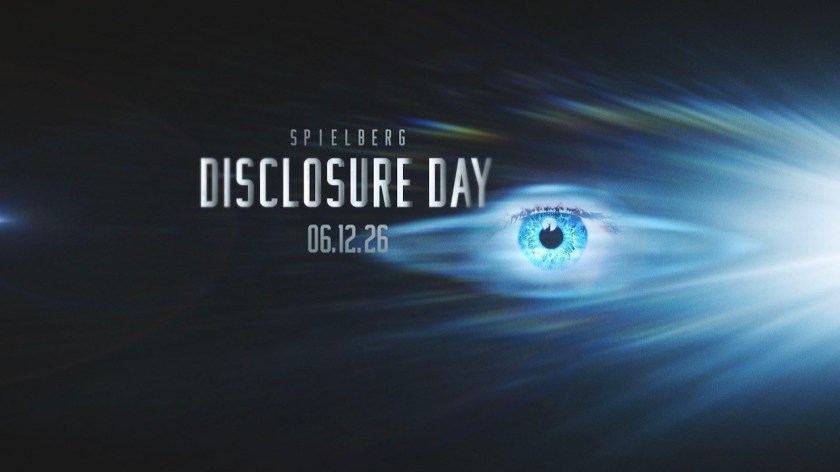
*Spoiler warning*
If you saw proof beyond a reasonable doubt that God was real, would you cease to have faith in Him?
I was born in 2002. During my lifetime, Steven Spielberg has directed 16 feature films, including Disclosure Day. Can you name 10 of them? How about five? The filmmaker who delivered one classic after another throughout the 1970s, 1980s, and 1990s has, surprisingly, made most of his best work before I was even born. Jurassic Park and Schindler’s List both arrived in 1993. Meanwhile, films like War Horse and The Adventures of Tintin, hardly the titles most people think of when discussing Spielberg’s greatest work, were released both in 2011.
Disclosure Day marks the fifth collaboration between Spielberg and screenwriter David Koepp. Their last three projects have all revolved around extraterrestrial life, suggesting a fascination both creatives share. Their first alien-centered collaboration, 2005’s War of the Worlds, reimagined H. G. Wells’s century-old novel through the eyes of ordinary civilians. Much of the film’s power came from that perspective, transforming an alien invasion story into a reflection of the fear and uncertainty that followed the September 11 attacks. (Please find my thoughts on that film here: How to Scare an Audience: War of the Worlds)
Spielberg has stated multiple times that, ever since he was a boy, he has been interested in the mysteries of the night sky. He specifically cited a 2017 New York Times article titled “Glowing Auras and ‘Black Money’: The Pentagon’s Mysterious U.F.O. Program” as what kick-started this movie idea. Though the frame here is a whistleblower attempting to release evidence of the man’s close encounters with the third kind, Disclosure Day feels like a response to the United States Government’s handling of the Epstein files.
Beneath that layer of subtext, however, the film asks even larger questions. How would humanity react if intelligent extraterrestrial life were proven to exist? How would such a revelation affect religion and faith? If humanity was made in God’s image, where would extraterrestrial life fit into that understanding of creation? Which political and cultural divisions would suddenly seem insignificant, and which would become even more important? And if you were the person holding evidence that could transform humanity’s understanding of its place in the universe, would you release it?
One of the film’s most intriguing ideas is the tension between faith and proof. If God were proven beyond any reasonable doubt, would faith still be faith? Disclosure Day repeatedly returns to that question, suggesting that certainty may not eliminate belief so much as transform it. Would you show the world? That question hangs over every major character decision in Disclosure Day. Some see disclosure as a moral obligation. Others see it as a potential catastrophe.
Full disclosure: after watching his newest alien blockbuster, the Steven Spielberg who made Raiders of the Lost Ark and Jaws, not the one who made The BFG and Ready Player One, is back.
Disclosure Day‘s success relies largely on its initiative from the Director, Writer, and Composer, the latter being a long-time collaborator of Spielberg’s, John Williams. Its score is beautifully haunting. It leaves scars. It tells a story of its own, yet also enhances the film’s polish. What resonates with many fans and general audiences about Spielberg’s work is his ability to define movie magic, and part of that is really good music. it marks another remarkable entry in Williams’ legendary body of work. I feel it has also been a long time since we’ve gotten a truly spectacular score from him. At 94, he delivers.
This film manages not to make me hate an Emily Blunt performance. Well done, Steven! She leads the cast as a weatherman who is constantly moving around, looking for her purpose and place. I felt this idea tied well with the film’s theme, which is the buildup to the public’s revelation of alien life. Over the course of the film, we see her character change, emotionally and, in some ways, literally. Given some of her connections to the aliens, she is seen by some as a threat and by others as a deity. Something to be worshiped.
I loved when one of the side characters made the sign of the cross over her body as she began to kneel. Blunt’s character freaks out, saying something along the lines of, “I will not be anyone’s religion.” There is a lot of evidence that her character serves as an allegory for Christ, from her costume design to the way she talks to people. Throughout the film, Christ and Christianity were also brought up multiple times, so it’s not far-fetched for me to say that. We’re introduced early on to the fact that she is a pretty anxious person. As she uses her powers more and more, she becomes calmer and more reserved. It was clear what Spielberg was trying to say with her.
One of the most intriguing aspects of her abilities is the way she seems to instinctively know where to go and whom she needs to find. This element stood out because it echoes themes found in both UFO lore and religious traditions. Some individuals who claim to have experienced alien abductions, including authors Jim Sparks and Whitley Strieber, have reported developing heightened intuition or other unusual abilities afterward. Similarly, Christianity teaches that the Holy Spirit can guide and prompt toward certain actions or decisions. While these concepts emerge from very different belief systems, both involve the idea of an unseen force providing direction and insight beyond ordinary perception.
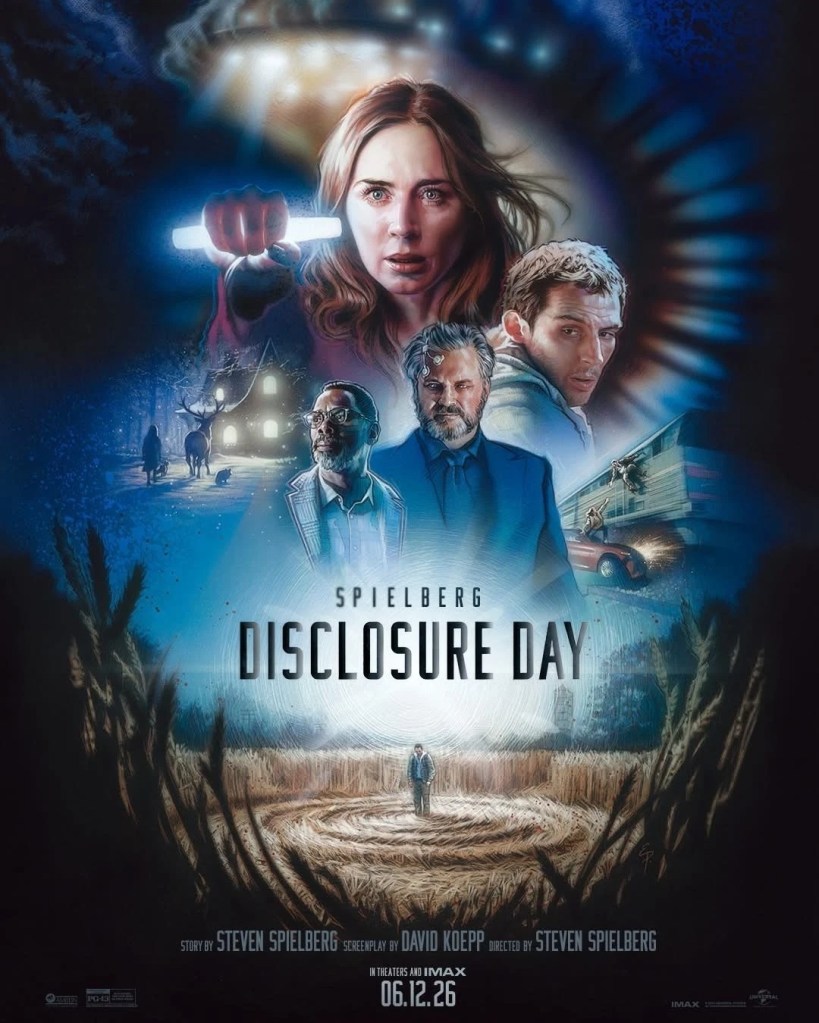
This idea was also shown from the character dynamic between actors Josh O’Connor and Eve Hewson. They play boyfriend and girlfriend, and O’Connor is the one who stole the files with the intent to release them. One of the film’s best moments comes from their debate over the morality of revealing the truth to the world. She believes that people are not ready for it, that it would destroy belief systems and civilizations. Her claim is that entire societies are based on worshiping a higher deity by faith, and if you were to show them a real being that is literally a higher deity, it would devolve into chaos. O’Connor, on the other hand, believes that people’s reactions are not up to him and that revealing the truth is most important.
Hewson’s character is not really in the 2nd half of the film, but her development was the most interesting to me. We find out that she was on track to become a nun but left after losing her faith in God. At one point, she has a conversation with the nun who was teaching her, who tells her, “I don’t think you lost faith in God, you lost faith in people.” Her turning point really made the movie for me. She realizes that it is not up to her to decide the salvation of the public’s souls, metaphorically. I thought that element of the film was fantastic.
Potentially, my favorite scene comes when Colin Firth (who I don’t have time for a full paragraph on, but was awesome as the villain) uses alien tech to locate Hewson and project himself there. He does this in an attempt to convince her not only to kill O’Connor but also that doing so is the right thing to do. In this scene, he’s given information about her religious past and invokes Christ’s prayer in the Garden of Gethsemane, where Jesus asks the Father that, if it is His will, the burden before Him might pass away. While he has the alien tech in his hand, trying to manipulate her, she has a cross necklace in her hand, and squeezing it to the point of bleeding is the only way to get out of this trance.
A common complaint I’ve read about Disclosure Day is its ending and its overall use of aliens. Maybe I’m losing my touch or just not aligned with the trends, but I vehemently disagree with those arguments. There are aliens and alien tech all over the film. The movie is about the lead-up to revealing the truth to the world. Would you show the world? I thought ending it without giving any answers about how the world reacts beyond the initial reveal was the right choice. Do you really want scenes of the United Nations debating how they were gonna use this to ask for more money for an entire 3rd act, or see people rioting with signs that say “Earth Life Matters”? I did not.
It also made perfect sense that they would choose to release the videos through a local news network rather than on social media. Not only does it connect to the surface-level plot, with Emily Blunt’s character reporting the story, but it also ties into the film’s larger concern with trust and credibility. Throughout the movie, a background subplot (seen exclusively through television broadcasts) shows tensions between the United States and Russia steadily escalating. When the disclosure finally happens, major news networks abandon that story to focus on the revelation of extraterrestrial life instead. The implication is clear: some discoveries are so significant that they render our political divisions temporarily insignificant. In a very David Koepp fashion, however, the film never stops to explain this outright. It simply assumes the audience will connect the dots.
I can’t see any film topping Disclosure Day as my favorite movie of 2026. It met my expectations and then surpassed them. More than anything, it was refreshing to see a modern Spielberg film that truly lived up to the remarkable legacy attached to his name. And yes, for those who know what I’m talking about, the movie absolutely addresses themes that were raised in another alien Spielberg film, Indiana Jones and the Kingdom of the Crystal Skull. I’ll leave it at that.
There are moments where the film feels a little clunky, and not every idea lands perfectly. Yet its themes are so compelling that they overshadow most of its flaws. Walking out of the theater, you won’t be thinking about the rough edges, the pacing, or the unanswered questions.
You’ll be thinking about one thing:
Would you show the world?

